Double balloon enteroscopy is usually chosen when earlier testing has identified a reachable problem, or when important bleeding or disease remains unexplained after routine investigations. By the end, you will know which findings justify referral, how doctors select the test and insertion route, what treatment can happen during the procedure, and how to prepare.
Key takeaways
- Consider DBE for suspected small-bowel bleeding after negative gastroscopy and colonoscopy.
- Use capsule endoscopy or imaging first when direct treatment is not yet needed.
- The oral route reaches more proximal small-bowel lesions; the anal route reaches distal lesions.
- DBE can biopsy lesions, stop bleeding, remove polyps and treat selected strictures.
Which findings make DBE worth considering?
DBE is worth considering when a finding requires direct inspection, biopsy or treatment beyond the reach of gastroscopy and colonoscopy. Common triggers include suspected small-bowel bleeding after negative gastroscopy and colonoscopy, persistent or recurrent bleeding despite an unrevealing capsule study, and an abnormal capsule endoscopy showing a bleeding point, ulcer, polyp or other lesion.
| Option | Finding or question | Usual role before DBE |
|---|---|---|
| Capsule endoscopy | Possible mucosal bleeding or small-bowel disease | Surveys the lining; an abnormal result can guide DBE |
| CT or MR enterography | Small-bowel stricture or mass, wall thickening or suspected Crohn’s disease | Maps the bowel and checks whether capsule passage is safe |
| DBE | A reachable target needs biopsy, removal, dilation or bleeding treatment | Confirms and treats selected lesions |
Imaging that shows a small-bowel stricture or mass is a strong reason for specialist referral, especially when capsule endoscopy cannot safely pass a narrowing or cannot define a deeper wall lesion. A retained capsule, suspected Crohn’s disease beyond routine-scope reach, selected polyps and hereditary polyposis syndromes can also prompt DBE.
DBE is not a sensible first investigation for isolated abdominal pain, uncomplicated bloating or functional bowel symptoms without bleeding, abnormal imaging or another specific concern. Its deeper access requires sedation or anaesthesia, so choose a less invasive test when the result would not change treatment.
Active heavy bleeding or suspected obstruction may require urgent imaging or hospital management instead.
How do doctors choose between capsule endoscopy, imaging and DBE?
Start with routine upper endoscopy and colonoscopy when small-bowel bleeding is suspected. If both are unrevealing and you are stable, capsule endoscopy usually surveys the small-bowel lining before an invasive procedure. A suspected narrowing changes that sequence: capsule retention is possible, so CT enterography, MR enterography or a dissolvable patency capsule may come first.
| Option | Best use | What happens next |
|---|---|---|
| Capsule endoscopy | Surveys the mucosal surface for ulcers, bleeding points and small polyps | Consider DBE if an important finding needs biopsy or treatment |
| CT enterography | Shows masses, strictures, mural thickening and surrounding structures | Use DBE when the lesion needs tissue diagnosis or endoscopic therapy |
| MR enterography | Maps mural disease and strictures without ionising radiation | Often preferred for repeated assessment or selected younger patients |
| Bowel ultrasound | Monitors selected inflammatory bowel disease, including bowel-wall changes | Escalate to cross-sectional imaging or DBE when findings need clarification or treatment |
| Standard enteroscopy | Treats or samples a target within its reach | Choose DBE when the lesion lies farther into the small intestine |
| DBE | Reaches deeper bowel for biopsy, bleeding control, dilation or retrieval | Use when the result will change management |
A positive capsule study does not automatically justify DBE. Doctors weigh the lesion’s importance, accessibility and planned action; DBE is most useful when biopsy or treatment is needed, not merely to re-document an incidental finding. For isolated nonspecific pain or uncomplicated bloating, its sedation and procedural risks usually outweigh the likely benefit.
What makes double balloon enteroscopy different, and which route is used?
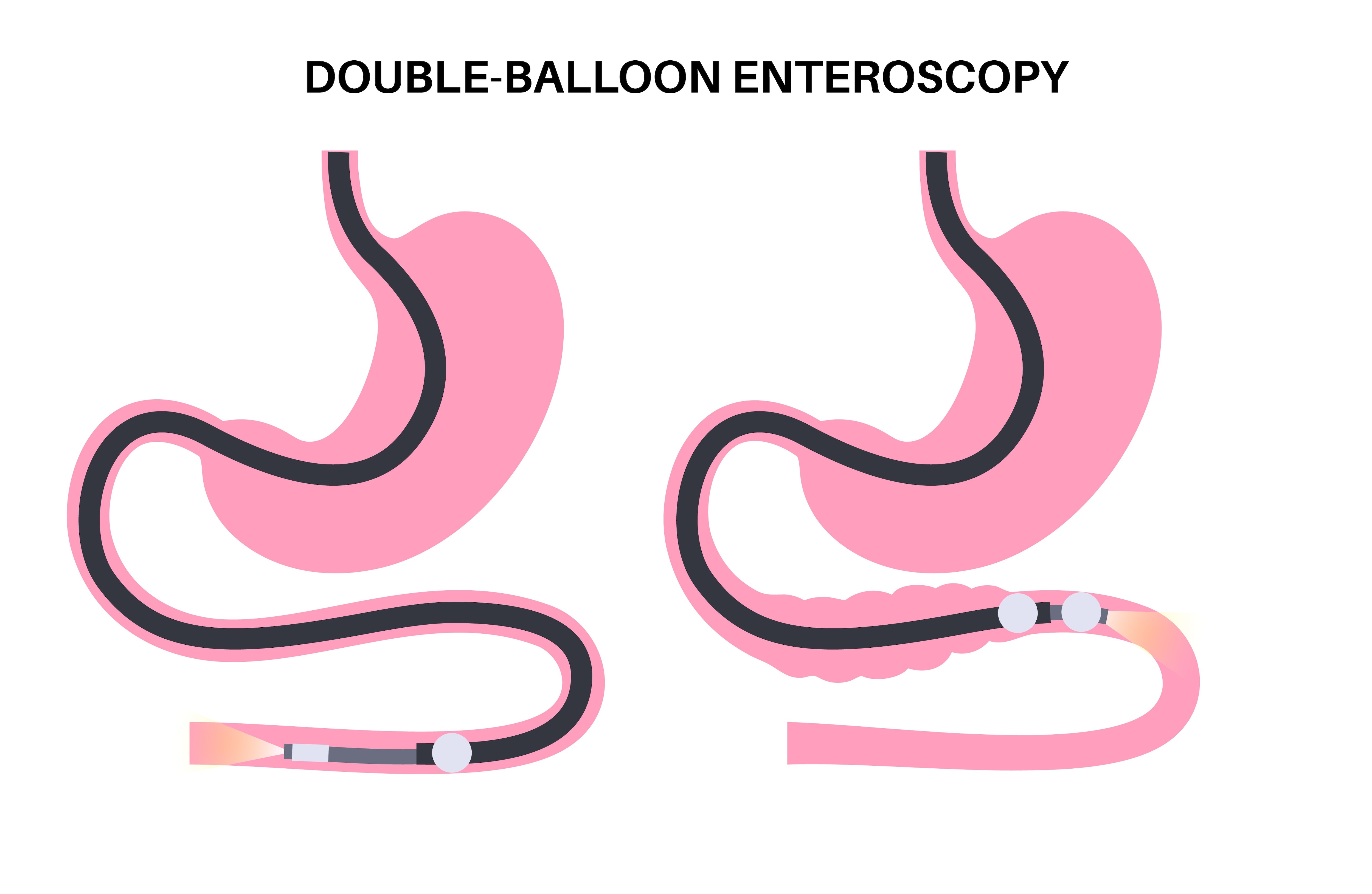
An overtube and two independently inflating balloons make the double balloon enteroscopy mechanism different from standard enteroscopy. The balloons alternately anchor the overtube and the endoscope, pleating the small bowel over the scope instead of simply pushing against its loops. This allows deeper insertion, but the technique takes longer and demands greater technical control.
| Route | Access and usual target | Main limitation |
|---|---|---|
| Antegrade DBE route | Through the mouth, reaching the upper or middle small bowel | The distal ileum may remain beyond reach |
| Retrograde DBE route | Through the anus and colon, reaching the distal ileum | The upper small bowel may remain beyond reach |
Doctors choose the route from the suspected lesion’s location, using capsule images, CT or MR enterography, a previous endoscopy, and any tattoo placed during an earlier procedure. A lesion estimated near the stomach or jejunum favours the antegrade DBE route; a lesion near the terminal ileum favours retrograde access.
One session does not guarantee inspection of the entire small intestine. The bowel’s length, adhesions, angulation, altered surgical anatomy, and the chosen entry point can stop the scope before it reaches the opposite end.
If the target remains inaccessible, a second DBE from the opposite direction may be needed; a tattoo can help identify the area and guide that examination or later surgery.
What can diagnostic and therapeutic DBE accomplish?
Diagnostic DBE lets the endoscopist inspect sections of small bowel beyond routine-scope reach and take targeted biopsies. It is useful for an abnormal capsule or scan, suspected Crohn’s disease, selected hereditary polyposis syndromes, or a lesion that needs tissue confirmation rather than immediate treatment.
| Diagnostic DBE | Therapeutic DBE |
|---|---|
| Inspection and biopsy of a suspected lesion | Treatment during the same procedure when the target is suitable |
| Clarifies inflammation, tumour, unexplained bleeding or polyp type | Argon plasma coagulation for selected bleeding lesions, polyp removal, dilation of suitable narrowings, and foreign-body retrieval |
| Can tattoo a lesion to guide a later operation | Can combine diagnosis and treatment, reducing the need for a separate procedure |
DBE can retrieve a retained capsule and reach difficult segments in surgically altered anatomy, including selected Roux-en-Y or Billroth II reconstructions. In experienced centres, enteroscopy-assisted ERCP may reach a distant afferent limb and the surgically connected bile or pancreatic duct; success depends on the reconstruction and local expertise.
The benefit is deeper access with an intervention option, but the procedure takes longer and often requires deep sedation or general anaesthesia. Risks include pancreatitis, bleeding, perforation, aspiration, abdominal pain or distension, and sedation reactions.
Risk increases when treatment is performed, so DBE needs a defined plan—biopsy, therapy, surgery or surveillance—not use as a screening test.
How should you prepare for a DBE referral and consultation?
Bring every result that could change whether DBE will alter your care, not only the report that triggered the referral. Include capsule-endoscopy images, CT or MR enterography reports, haemoglobin and iron results, previous gastroscopy, colonoscopy and enteroscopy reports, and the reason the examination was requested.
Prepare for the consultation by checking these points:
- Ask which route is planned. An antegrade DBE through the mouth requires fasting; a retrograde DBE through the anus also requires bowel cleansing.
- Give the team a complete medication list. Instructions for anticoagulants and diabetes medicines must be individualised because stopping, continuing or adjusting them carries different risks.
- Report allergies, sleep apnoea and possible pregnancy before sedation or anaesthesia is arranged.
- Ask what happens if the endoscopist finds a lesion: biopsy, endoscopic therapy, surgical referral, medication adjustment or surveillance.
- Ask whether a suspected narrowing makes capsule retention a concern and whether CT or MR enterography, or a dissolvable patency capsule, is needed first.
A positive capsule study does not automatically make DBE worthwhile. The suspected lesion must be clinically important, reachable by the chosen route, and likely to change treatment rather than simply re-document an incidental finding.
Dr. Harshad Joshi can use your records to weigh DBE against a safer test and clarify whether the intended next step is biopsy, therapy, surgery or surveillance.
Related service
Endoscopy Enteroscopy ₹70000 Enteroscopy is a medical procedure used to visualize and examine the small intestine, which is located between the stomach and the large intestine... |
Frequently asked questions
Which findings make double balloon enteroscopy worth considering?
DBE is worth considering when bleeding persists after negative gastroscopy and colonoscopy, capsule endoscopy shows a lesion, or tissue sampling or treatment is needed.
How do doctors choose between capsule endoscopy, imaging and DBE?
Doctors match the test to the question: capsule endoscopy surveys the small-bowel lining, CT or MR enterography assesses the bowel wall and surrounding structures, and DBE provides direct access for biopsy or treatment.
What makes double balloon enteroscopy different, and which route is used?
DBE uses an overtube with inflatable balloons to advance a flexible endoscope through the small intestine. The oral route reaches the upper and middle small bowel; the anal route reaches the lower small bowel.
What can diagnostic and therapeutic DBE accomplish?
DBE can inspect suspicious areas, take biopsies, control bleeding, remove selected polyps, retrieve foreign bodies and treat some narrowings.
How should you prepare for a DBE referral and consultation?
Bring previous endoscopy, capsule and imaging reports, a complete medicine list, details of bleeding or pain, and information about blood thinners, diabetes and allergies. Follow the centre’s fasting and bowel-preparation instructions.