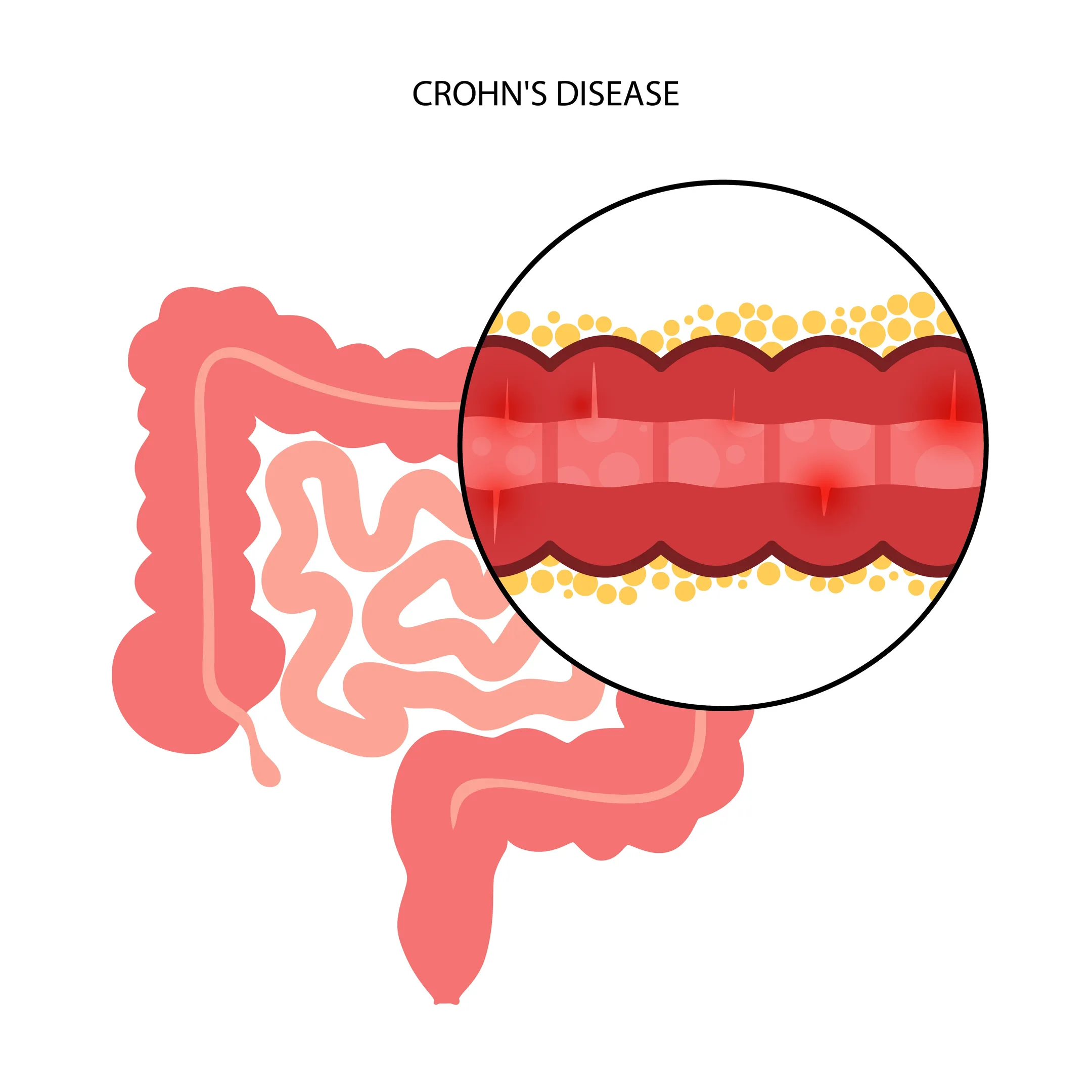
Crohn's Disease and Ulcerative Colitis are the two major forms of inflammatory bowel disease. Because both can cause diarrhoea, abdominal pain, bleeding and fatigue, patients often assume they are essentially the same condition.
They are related, but important differences influence investigation, monitoring and treatment decisions.
Where does the inflammation occur?
The most straightforward difference is the location.
Ulcerative colitis affects the large intestine. It usually begins in the rectum and may extend upward through part or all of the colon in a continuous pattern.
Crohn's disease can occur anywhere along the gastrointestinal tract, although the end of the small intestine and colon are commonly involved. Healthy areas may sometimes appear between inflamed sections, creating what clinicians describe as skip involvement.
Crohn's inflammation can also penetrate more deeply through the intestinal wall than the inflammation typically seen in ulcerative colitis.
Do the symptoms differ?
There is considerable overlap.
Both conditions can cause
- Frequent loose stools
- Abdominal cramps
- Urgency
- Fatigue
- Reduced appetite
- Weight loss
Bloody diarrhoea is particularly associated with ulcerative colitis, although bleeding can occur in Crohn's disease too.
Crohn's disease may sometimes produce complications such as narrowing of the intestine, abscesses or fistulas because inflammation can extend deeper into the bowel wall.
Symptoms alone, however, are not reliable enough to distinguish the two conditions.
How do doctors tell them apart?
Evaluation may include stool and blood tests followed by endoscopic and imaging investigations where appropriate.
Colonoscopy allows direct assessment of the colon and terminal portion of the small intestine and enables biopsies to be collected. Cross-sectional imaging may provide additional information, particularly when small bowel Crohn's disease or complications are suspected.
The overall diagnosis is made by combining the clinical history with investigation findings rather than relying on a single symptom.
Is treatment the same?
There is overlap in the medicines used to manage both conditions, including selected anti-inflammatory, immune-modifying and biologic treatments.
However, therapy is individualised according to factors such as
- Disease location
- Severity of inflammation
- Presence of complications
- Previous treatment response
- Other health conditions
- Treatment risks and monitoring requirements
Surgery also has a different role in the two diseases.
Removal of the colon can eliminate colonic ulcerative colitis, although it is major surgery with important long-term considerations. Surgery for Crohn's disease may be needed for complications, but it does not eliminate the underlying tendency for inflammation to recur elsewhere in the gastrointestinal tract.
What about diet?
Neither condition should be managed solely through arbitrary food restriction.
During active symptoms, some patients may tolerate certain foods differently. Nutritional deficiencies also need attention, especially in Crohn's disease involving the small intestine or following intestinal surgery.
The appropriate dietary approach depends on disease activity, nutritional status and individual tolerance.
Why getting the distinction right matters
Repeatedly treating diarrhoea or bleeding without determining the underlying diagnosis can delay appropriate care.
For Mumbai patients, especially those experiencing persistent diarrhoea, recurrent bleeding, unexplained weight loss or symptoms that keep returning after temporary treatment, evaluation for inflammatory bowel disease may be appropriate.
Dr. Harshad Joshi sees patients with gastrointestinal and inflammatory bowel concerns in Mumbai, helping establish whether symptoms are related to Crohn's disease, ulcerative colitis or another digestive condition.
The important question is not simply whether someone has colitis. It is what type of inflammation is present, where it is located, how active it is and whether complications have developed. Those distinctions create the foundation for a more targeted treatment and monitoring plan.
Keywords